Sunday, April 24, 2016

Talking 'bout the birds and the bees, and the flowers and the trees


Prairie Moon Nursery photo


The roadside ditches ripple silver with runoff from the snow still lingering in the shadowed woods, and a wind from the northwest howls cold and wild around the eaves.  A week ago, the winter loosened its stubborn hold.  The sun shined; the temperatures rose, and the rivers and streams reached flood levels, leaving us holding our breath and wondering who might be flooded.  The warmth and sun send us outdoors, longing to break the forced confines of the house.  We cleaned flower beds left undone in the fall, edged sod from the driveway, pulled back the mulch from the parsnips, anticipating their sweetness.  But the earth was still frozen, and so the parsnips will wait a few days or maybe weeks before they make their way to our table. 
  We are anxious for spring, especially after a winter that really wasn’t, at least not by northern Maine standards.  Oh, we had snow, and a few weeks of temperatures below zero, but usually those storms came in like a blizzard but petered out a day later to rain, then more cold so the worlds was coated in ice.  It was impossible to snowshoe, more impossible to drive and so we were housebound.  But spring must come, and though the wind and cold have been persistent, the sun rising higher in the sky, the sunlight stretching longer each day melted away the snow in the fields that are now shades of dun and sienna, brown, and tan, stubble and furrows waiting for someone with more patience than we show to come and coax them into production.
Spring seems to be tardy in spite of the deer gathering daily in the back field to munch the slowly greening grass.  The popples have not put out their furry catkins and even the distant hills seem stubbornly gray, not blushed pink with burgeoning leaf buds.  The soil is still frozen two inches down and the live plants I ordered – pussy willows shoots and common blue violets, red flycatcher and more asparagus – are safely stored in the refrigerator alongside salami and cheddar, leftovers and condiments.  Warmth cannot come too soon. 

Deer in the garden -- taken from indoors

We have begun the spring planting, however.  The rickety folding tables have been set up in front of the kitchen window, and on them are trays of onion seedlings and leeks, as well as hydroponic planters – a new and delightful purchase this year – exploding with herbs and vegetable seedlings.  We purchased one of the planters at the urging of my friend and colleague, Laura, who grows cherry tomatoes and fresh herbs year round in hers.  Along with the planter, we chose herbs: Genovese and Thai basil, dill and mint, parsley and cilantro.
Parsley, cilantro and rosemary
The ambitious dill and Genovese basil sprouted within a day, stretching up in their little domes toward the LED lights on the grower, and a few days later the Thai and the mint.  We bought another grower, and peat plugs to plant vegetables. Now there are a dozen and a half Roma and Mortgage Lifter tomatoes, broccoli and Brussel sprouts, hot and sweet peppers, reaching their green leaves upwards to the light.  Bruce dug out the seed flats and planted the onions and leeks in regular potting soil, but we also ordered an LED light, and soon they were up and stretching tall. 
We have long begun our own seeds, but here in the north, the plants just couldn’t get enough light and grew fragile and spindly.  For the past two years, we have had a friend who owns a nursery start our tomatoes and that has worked well, but there is a joy in watching the seeds sprout, the first tender leaves stretch upward.  The growers make that possible again. I stop a couple times a day, at least, to check the progress of our future meals. 
Rosemary blossoms
We order seeds each year from the same companies, and my herbs come mostly from Richters in Canada.  They have an amazing selection of herbs and even more amazing descriptions of those herbs.  When the catalog arrives in January, I spend hours pouring over it, trying to decide what I will grow and plant.  There are the standard annuals – basil, cilantro, dill, parsley – that get planted in the main garden, but last year, we finally began shaping my backyard herb garden.  Although I bought a few plants from a local nursery- bee balm and lavender, lemon balm and catnip, and I have a few plants – mints, oregano and chives, there is still a lot of area to plant.  I went on a buying spree.
In part, this was because ten years ago when we first began shaping this homestead, all we had to work with was played out soil left from years of potato production.  The first year, and the second, and truth be told, the third and the fourth were spent picking rocks and digging weeds.  We composted and brought in manure, mulched with hay and straw, and slowly the soil improved.  We built a raised bed for the asparagus, and then I began work on the herb garden.
Tomatoes, broccoli, brussels and peppers
It is built into a slight slope, raised with fieldstone, not the flat smooth kind that makes great patios and pathways, but real fieldstone.  Rocks we dug out of the garden and the lawn or picked up along roadsides and turned into a wall that looks as if it has always been there.  We filled it with compost and whatever Perham tilth – a gravelly silt loam – we had left over from other projects.  I set in flat stones to make a series of two steps up into the garden area, planted creeping wooly thyme along the upper edge of the rock wall to hold the soil, and tucked in some chives, oregano, chocolate mint and catnip.  As we got busy planting the vegetable garden, I promised myself I would get it under control and planted – soon. 

Onions and leeks

Last summer, with the rest of the growing under control, Bruce and I began designing and redigging the herb garden.  We screened the soil, laid out walkways, built low walls to shelter the more tender herbs, and designed a simple yet effective picket fence and archway for the garden.  And then life got in the way.  The vegetables and fruits that we rely on to eat throughout the winter started coming in, and in spite of our best efforts, the herb garden again got shot shrift.  I managed to tuck in some lavender, bee balm, and lemon balm, and then things stopped as I headed west to do research to finish my doctorate.  I mourned the completion of the garden, but on that trip I found new inspiration.
When we first bought our land, it was about twelve acres of overworked fields and another eight of overcut woods.  Along the verges of field were chokecherries, a few scraggly raspberries, and native hazelnuts.  Little more.  That first year, we hastily dug in the plants we had brought with us – a couple roses, the oregano, mints, chives, comfrey, horseradish, and rhubarb, and bought a couple cords of wood and settled in for the winter.  We fared well.
The next spring, our son-in-law plowed and we planted the first garden patch, and we began building lawn, planting some birches and mountain ash trees, and a couple of slips of lilac.  Each year we added to it. Crab apple trees, bush cherries, and apple trees, and we expanded the garden, planted asparagus, donated raspberries, and high bush blueberries.  With every addition, more birds flocked to our yard, including the hummingbirds, for which we named our farmette.  But in Wisconsin, on a day off from researching, Kasey and I roamed a farmers’ market, stumbling upon a cooperative extension service table and discovering wild native plants from Prairie Moon Nursery and Prairie Nursery. The two offered native plants, especially targeted for native pollinators, bees, butterflies, and hummingbirds.  I grabbed two catalogs and fell in love with what the pages contained. 
If you haven’t heard, bees are having a terrible time of it.  Whole colonies are dying off, and the reason is not yet fully explained.  Some blame pesticides, others fault pollution.  Probably it is the result of both.  Native plants, however, are not genetically modified and provide a safe haven food source.  Better yet, much of what I was growing or planned to grow for the herb garden, and the additional bushes – elderberry and Saskatoon berries – we had just planted – fit in fine with providing a pollinator Eden by securing plants and seeds from the two nurseries.  And so we continue our adventure, but with new purpose.
Sustainable has new meaning now. It is not enough to feed ourselves with freezers full or frozen berries and veggies.  Not enough to buy local honey and meat.  Not enough to buy our eggs fresh.  Rather, we will continue to expand our pollinator’s Eden by planting those flowers and plants that are not only beautiful but also serve a beautiful purpose: feeding the bees, and butterflies, and yes, hummingbirds that help feed all of us.  At least I will once the weather warms enough to thaw the ground and get the plants outside. 

Busy bees.


Sunday, April 3, 2016

This Capricious Spring


This capricious spring, shadow and light, the tug of spring and the pull of winter has us anxious and longing for warmer days.  One day the blue bowl of sky is so bright and clear it hurts the eye, and the next there is the thin opaque gray dome that bodes of snow.  It has been a long winter, filled with sleet and frozen rain and heavy wet snow.  The remains of snowbanks along the roadsides smudged and dirty with the sand and gravel flung airborne by the plow trucks, scarred and sooty, and beyond, the fields are sheened with ice from the last mixed storm.  It reminds me of childhood when some winters we could strap on ice skates and glide across the frozen fields, our shadows snaking along behind us or dancing ahead in daring. 
I change my coat daily;
on one, the red wool coat, and another the down parka.  Mittens and gloves are interchangeable too, and the heavy snow boots give way to flats, and then back to the boots.  It is tiring to keep up, especially when we long to be outdoors, something that has not been possible this year.  There was no snowshoeing, because snowshoes slid on icy snow and trails, and little cross-country skiing either.  We’ve even held off from walking the dogs too often because the frozen ice on the road cuts the pads of their feet and leaves them limping home to the warmth of the house where they curl in their chairs and dream doggy dreams, noses and paws both twitching in the chase of rabbits and squirrels and birds.  We all have cabin fever.
But spring is coming.  The rivers and streams are bank swollen, cold water running in a swift liquid ribbon, overflowing, soaking the ankles of alders and service berry, wild cranberry and cattails.  The moose have been on the move, perhaps because our neighbor had his woodlands thinned and for nearly a month, behemoth timber trucks hauled load after load of long straight logs out of the woods down near where Salmon Lake Brook leaves what passes for Salmon Brook Lake, but only if one doesn’t look too close.  It is really a bog, preserved by the state because of the 1,800 acres of wetlands and six rare plants that call it home.  The local critters call it home, too.  Bear den up deep in the woods, and moose gather along the edge of the bog where young trees and bushes provide good winter feed while the taller evergreens offer protection from deep snow.

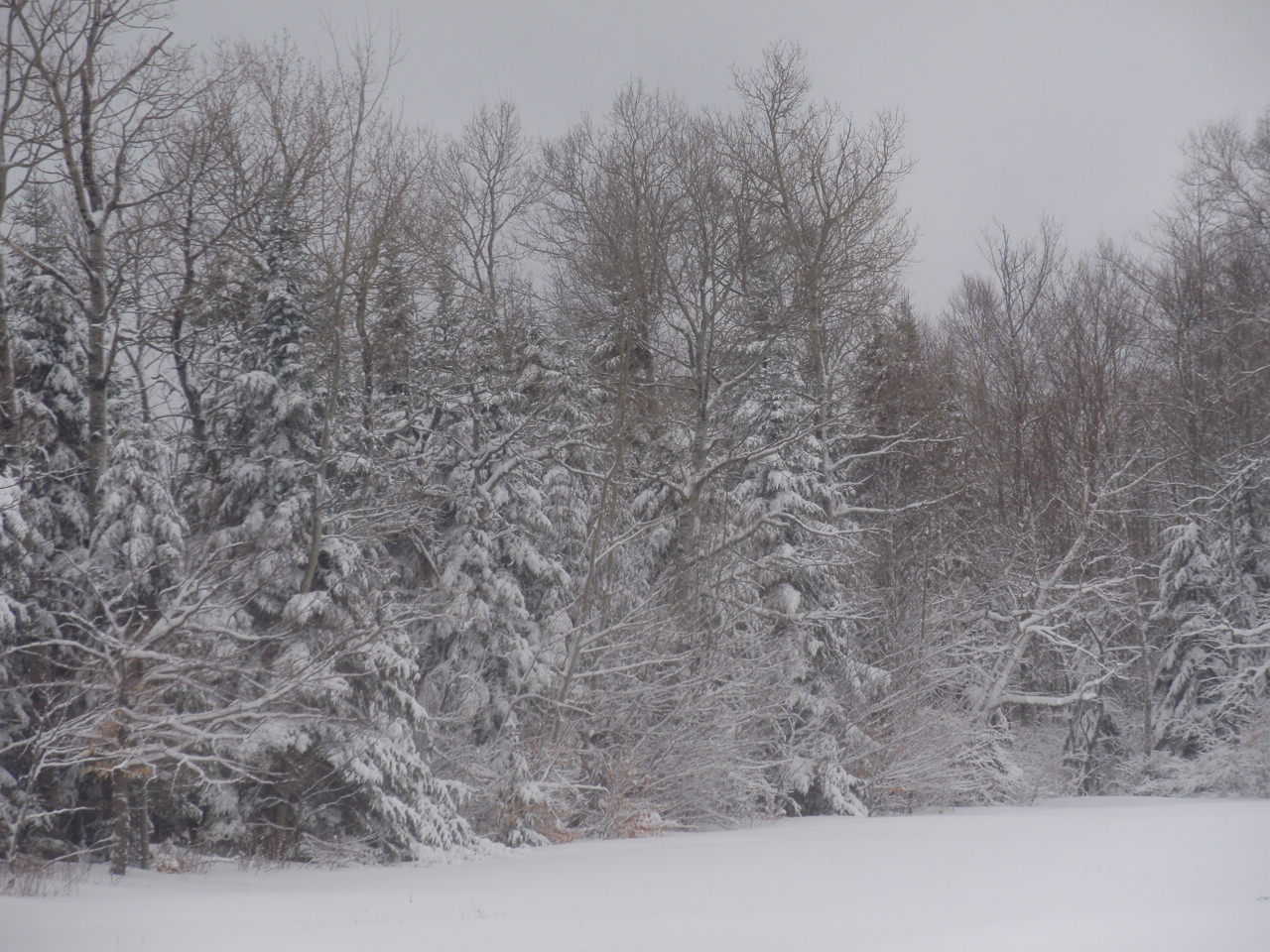
Salmon Brook Lake in winter

We often see their tracks, cutting across our field, zig-zagging the overgrown field on the far side of the road where the wild apple trees grow.  This year there were three: White Stockings, a mature cow who has been roaming these fields and woods since we moved here and likely far longer, and then two younger cows, who we suspect are her offspring because both have some variation of the white socks that earned White Stockings her name.  At some time, there had been a bull around too, because he knocked over part of our rail fence rubbing against it and broke the young birch tree we planted last fall.  The fence was easily fixed, and with a bit of pruning, the birch will likely survive too.  That is if the moose leave it alone and don’t treat it as dinner. 
All three cows were noticeably pregnant, rotund bellies swinging from side to side as they waded through the deep snow, eating everything that they could find – red stick, choke cherries, the old apple tree in the north windbreak of our property.  But they left our fledgling orchard of apples and cherries, and plums and hazelnuts alone, until a few weeks ago.

Fifty feet from the house

It was my husband’s fault. 
I had been watching the moose adventure for several weeks, and checking each morning to see if there were footprints in the snow around the fruit trees.  There had not been and I had kept my vigil silent.  Bruce, however, had fretted and worried all winterover the young trees, which had borne the first fruit last fall.  I suppose the imminent threat of moose drove him to breaking the silence.
“The moose haven’t gone after the trees,” he burst out one evening as I arrived home.  He just couldn’t contain himself.   I shook my head and hung up my coat.
The next morning, the damage was done.  The small orchard was laced with moose prints and not a tree was spared from their munching.
“They got all the new growth,” he said mournfully.
“Uh huh,” I replied. 
“Damn moose!” he proclaimed of the critters that the day before he had delighted in.
Sometimes, I do know when to be quiet, and so I was. 
The trees will recover, and with a bit of pruning, likely bear again this year because the fruit grows on older wood.  Next year, he says, he is putting up a fence.  Given the fate of the earlier mentioned rail fence, it seems like a lost cause.
And so we inch toward spring, our patience with snow and each other fraying.
The crows returned about the same time as the moose buffet, and that elevated Bruce's fury.  For the past three years he has waged a battle with a handful of crows that seem determined to set up housekeeping and raise a family in our neighborhood.  Bruce has shot one that ventured too close to the house, and fired into the air to scare off others too many times to count.  Now when he ventures outdoors and there are crows hanging out in the poplars, they raise a raucous alarm and flee. 

Bird Dog

Last week the robins returned too, just before the eight inches of heavy wet snow that nearly shut down the northern part of the county.  And the snow buntings packed up, all but a persistent pair, and headed north to their summer home.  There are chipping sparrows now cleaning up the seed leftover from feeding the buntings, and they offer all sorts of entertainment for the dogs, especially Kris, who woke up two weeks ago and realized he is a bird dog.  He is fascinated to watch them hip and hop and bob across the yard.I only hope the windows hold.
The coming of the birds means the planting of this year’s seedlings and so the tables have been taken down from the rafters of the garage and lined in front of the windows in the house.  Onions and other early seeds are tucked in to them, and the house smells of the warm dampness of starter soil.  We also bought a mini hydroponic set up, Aerogarden, at the urging of my friend Laura, and it is here that I am now starting herbs, and soon tomatoes and other seedlings for the summer garden.  The list of things to do grows longer every day, and we are anxious for the snow to melt away, the wind to come out of the south and not the cold northwest.
We are ready for spring to sweep across the land and turn the distant hills into delicate Monet vistas.  However, the temperature keeps dropping, down to eight above tonight, and so we will keep busy with planning and ordering seeds, and making lists of things to do, and dreaming of when the days of summer paradise finally arrive.  And this year, I won’t be writing a dissertation so I might get to enjoy it!


Sunday, January 3, 2016

It will be happier


The tree has been taken down; the ornaments packed away as we bid farewell to both another Christmas and another year.  They seem to pass faster now that there are no children running through our house, and we see our old friends pass on to other worlds.  Dear Beth this past summer, and Doug as well.  I always pour a finger or two of Tullamore Dew for my dear friend Michael, and make a batch of Karen Walker’s coconut bars.  It would not be Christmas without them.  And of course, there is my mother, only a year gone, and her still lingering presence catching up with me in the holiday rituals.
 This year, there was no marathon of cookie baking, nor breads made.   The Christmas cards, an old-fashioned and costly tradition in this age of instant communication, didn’t get out until after the holiday.  I stubbornly addressed and mailed the cards just so people knew we were thinking of them as the season passed.   Time was too tight, what with a dissertation to finish and a million student papers to grade.  It made for a quiet holiday.
Every year, I get anxious about Christmas, and when the gifts are all opened, the bright paper thrown away, I take a few minutes to reflect on the year that has been, and then begin working on resolutions for the coming year.  It is a time of reflection and memories, of clearing out the old, down-sizing a life that no longer has hordes of laughing teenagers gathered around the dining table, or staying up until midnight wrapping gifts to go beneath the tree. We have become efficient in our advancing age, tailoring such previously frenetic activities to current needs and energy.  There is wistfulness to it.


The cold of northern Maine in December and January keeps us inside more, and more things get done, which is often a surprise to both of us.  Closets and cupboards cleaned; furniture rearranged; dogs to be snuggled, a constant flurry of mindless busyness that leaves me remembering, both a joyous and dangerous thing. 
Two weeks before Christmas, my appendix burst.  I was eight, and for the past month, I had been sick on and off. Throwing up one day, fine the next.  My mother was sure it was just flu, and on the days when I wasn’t vomiting she bundled me off to school.  But at two in the morning, exactly two weeks before Santa was due to arrive, it all came to a head.  I awoke, crying from pain, and when mom took my temperature it was a startlingly 103 degrees. 
We lived in Vermont then, in a small neighborhood of newly constructed houses that seemed to have sprung from the hilltop that once had been hayfields and cow pastures.  The wall of windows in the living room looked out onto still worked fields and thick woods beyond.  The houses had been built to accommodate young doctors at the nearby Dartmouth Medical School.  There was a doctor to the right of us, and a doctor to the left of us, and another on the next street over. 
Within minutes of taking my temperature, my mother was on the phone, calling the closest, even though it was two in the morning.  And, like doctors did in those days, he threw on boots and a coat over his pajamas and carrying the then iconic black bag that all doctors had, waded through the deep snow and chilly night to check me out.  Less than an hour later I was bundled into the back seat of the family car and we were on our way to Mary Hitchcock Hospital.  My brother, three years younger, had been swept off to share a bed with the doctor’s son. 
The emergency room was bright and bustling when we arrived, causing me to shutter my eyes as my clothes were stripped from me and I was swooped up onto a stretcher. Within minutes, blood had been drawn, my stomach had been poked, and a four a.m. emergency surgery scheduled.  My mother and father hovered beside the stretcher, assuring me all would be well, and then I was whisked off to the operating room, even brighter and busier than the ER had been.  I do not remember falling asleep.

I woke up, alone, in a four-bed ward of the pediatrics floor.  Except for the slap of feet beyond the door, it was quiet.  Outside the tall multi-paned windows along one wall, the sun shone brightly in a blue sky.  Where there had once been a stabbing pain, there was now a persistent nasty ache, and when I moved even the slightest bit, it felt like someone was pulling my skin apart. 
I wondered where I was.  Where my parents were and how many days I had been asleep, and whether Christmas had come and I had missed it.  Had Santa passed me by?  Silent tears rolled down my cheeks, and then there was a nurse in a starched white uniform that crinkled when she walked, beside my bed reassuring me.  She checked my temperature, plumped the pillow, and then left, promising she would be right back.  She was, carrying a bowl of red Jell-O, and promising me that my parents were on their way.
“Can I go home?” I asked as I spooned the cool gelatin into my mouth. 
“Not yet, but soon,” she promised as she bustled around the bed, tucking in the sheet at the foot. 
My parents arrived soon. Bundled in heavy coats and wooly mittens, snow still sliding off their boots, they brought the smell of the outdoors cold into the over-heated ward.  I wanted to leap from the bed, fling myself at them, and beg them to take me home.  But I was stopped by the pull of the stitches that transected my stomach like a red bristly caterpillar,   Yes I had pulled up the cotton hospital johnnie to look.
They did what all good parents do, hugging me hard enough to break ribs, being overly optimistic about the surgery, but the worry was obvious on their faces.  They had brought comic books and a handmade card from my brother, and good wishes from the neighbors.  I felt cut off from the world and what was going on outside.  I longed to be out of the bed, Christmas shopping with them, sledding in the back yard with the rest of the neighborhood kids.  Not stuck in a bed.  But that was the way it was.
Ten days, the doctor who came in to chat with my parents said.  Ten days. Almost Christmas!
“But what about getting a tree?” I asked.  This was part of our ritual.  One Sunday afternoon after church we would all pile in the car and go to pick out the perfect tree. Not too tall, not too short. Not too full, not too skinny.
“We’ll get a tree,” my father said calmly. “Don’t you worry.

“But what about Santa?” I asked.  “Will he still come?” 
“Of course he will,” my mother said, just a little too brightly.
The doctor chatted with them for a few minutes more before having a whispered consultation with my mother near the door of the room.  Even then I was a terrible eavesdropper and I stretched to hear. Futilely.  A few minutes later, a starched nurse came in and ushered my parents away.  I was left around in that miserable ward.  Three empty beds all I could look at, and a bit of blue sky and bare branches through the windows. I was miserable. 
A week went by, and all I had been given to eat was Jell-O.  To this day, I hate Jell-O.  Can’t swallow it without gagging.  What I wanted was a hamburger.  Or maybe fried chicken.  That, the nurses explained to me over and over again, was not in my future.  Even at eight, I began to wonder what was in my future.
On the Friday before Christmas, my parents sprung me from the hospital, with the stern admonition from the doctor that I was to rest, rest, and rest.  Try telling that to an eight-year-old four days before Christmas!  But my father underscored the order, and sweetened the pot by promising that if I rested, on Sunday we would go get a tree.  Christmas was saved.
The next morning we all piled in the car and began the slow drive over snowy roads to visit the tree lots and find out tree.  Although I was made to wait in the car while everyone else roamed the snowy lots, Dad showed everyone to me as he surveyed them, and when at last we all agreed on a tree.  With the tree strapped to the roof, we made our way home.  It was feeling like Christmas.
The tree went up on Sunday, and I supervised from the couch.  I was tired, and complained little. One Monday I sat at the kitchen table and helped wrap a few presents, but it was hard to be up for long.  The incision hurt and I continued to tire easily.  Unusual only a few days before Christmas.
By Wednesday, I didn’t want to get up.  My stomach hurt terribly and I had no energy.  Out came the thermometer, and then a call to the hospital.  A half hour later, still in my pajamas and robe, I was wrapped in a blanket and carried out to the car.  We were headed back to the hospital.    
In the same emergency room, I was again poked and prodded, crying this time, and then admitted back to the same horrible ward I had spent nearly ten long days.  The incision had abscessed and Christmas Eve for me would be spent in the same miserable bed, an IV dripping in antibiotics, Santa unaware of where I was, in spite of my parents’ efforts to reassure me.  When the left at the end of visiting hours, I turned my back to the side and cried into my pillow.
I never heard the nurse come in, so she must have tiptoed, but she came around to the side of the bed I was facing and looked down at me.  In her hand she held a small radio.
“I thought you might like to listen to Christmas music,” she said gently.  My world brightened a bit. She moved the bedside table slightly and reached behind to plug the radio in.  The knob clicked as she turned it on, and then there were carols playing.  The world didn’t seem so bleak.  She smiled.
“Merry Christmas, honey,” she said softly.  And then she left.

I don’t know how long I stayed awake listening to favorite carols, but at some point I fell asleep, and then it was morning. Christmas morning.  The radio had been shut off.  Sunlight spilled in through the big windows.  My stomach didn’t hurt as much.
And then my parents were there, and my brother, too. He had been barred from visiting because he was too young.  And they were all laden with brightly wrapped presents.
“Santa came!” my brother shouted.  “We got a toboggan!” My mother shushed him quickly.
The presents got piled on the floor by the bed and one by one were brought to me.  Paper piled up on the linoleum floor, and my dad crumpled and stuffed it into a box they had brought. 
Finally, there was one large present left, and my dad lifted it onto the bed beside me. I tore the paper away quickly and started to cry.  Inside was the three-foot doll I had coveted for almost a year.  Her name was Patty.  Santa had not forgotten me.
It’s been almost a half century since that Christmas in the hospital, but I still believe in the magic of the holiday season. Every year my heart goes out to those who are alone, or sick, or alone and sick at a time so meant for families, whether it is Hanukkah or Kwanza or Solstice.  I’m nostalgic about Christmas.
I want snow, and cold weather, and candles in the winter, and Christmas cards hung on strings.  The soft glow and sweet scent of the evergreen tree, and all the foolish traditions that are part of our history with family.   And so I’ve resolved that when the dissertation is done, and the holiday season approaches next year, I will bake those cookies, and write the cards and mail them off to friends far and wide, and carry platters of baked goods to my neighbors, and trim the tree, and do something nice for someone who needs it.  For that is the way to end one year, in the glow of happiness, and to begin another looking forward, and wishing the best for all.